What if the secret to aging well was written — quite literally — in your chromosomes? Emerging research is pointing to one of the most overlooked structures in human biology: the Y chromosome. Once dismissed as a genetic footnote, this tiny but mighty chromosome is now at the center of a scientific revolution in longevity, cellular health, and the biology of aging in men.
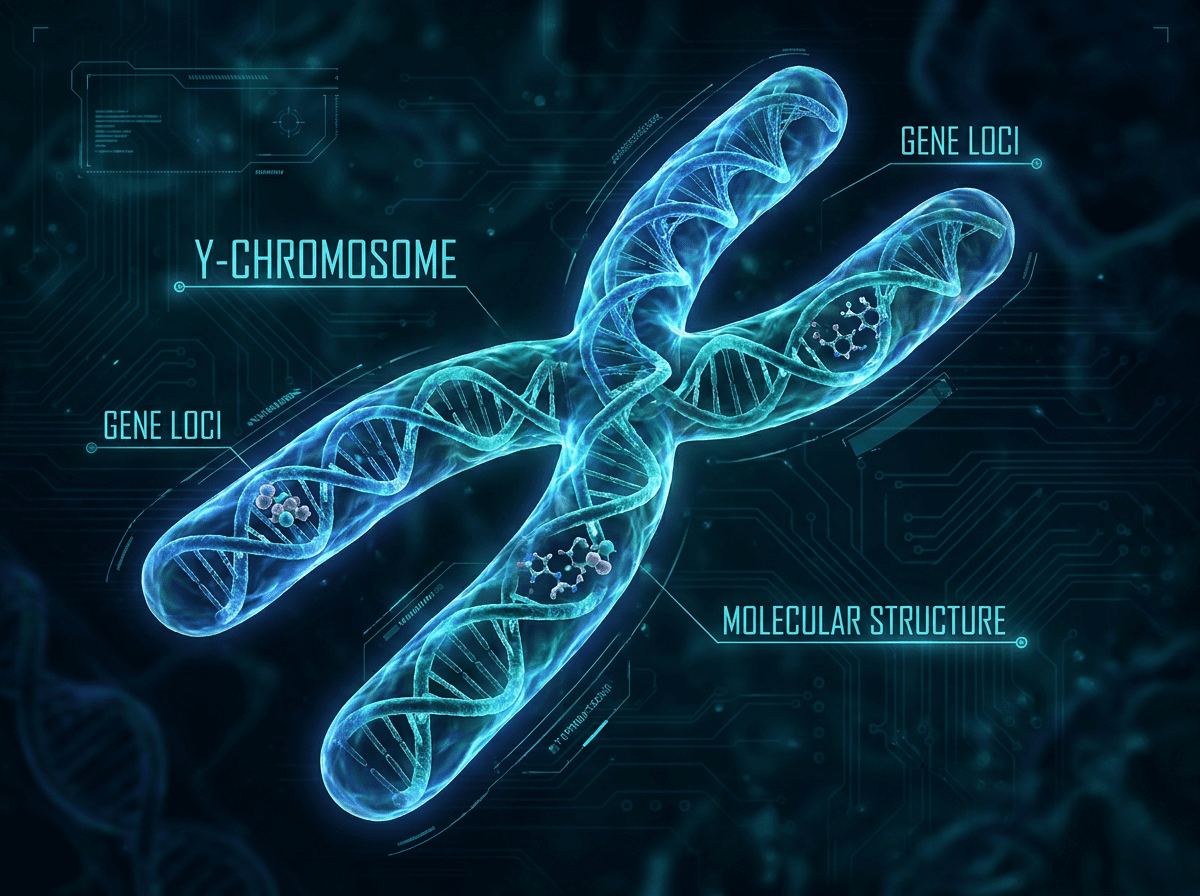
the Y chromosome: your hidden aging clock
The Y chromosome is the smallest and most structurally isolated of all human chromosomes. Unlike its counterparts, it carries no backup copy — no partner chromosome to repair mutations or compensate for cellular damage. This singular vulnerability makes it uniquely susceptible to what scientists now call Loss of Y (LOY): the gradual disappearance of the Y chromosome from aging cells, particularly in blood and immune tissue.
LOY is not a rare anomaly. Studies published in Nature Genetics and Science confirm that LOY accelerates significantly after the age of 40, and men with higher rates of LOY show dramatically increased risk of Alzheimer’s disease, cardiovascular failure, and aggressive cancers. The Y chromosome, it turns out, is not merely a sex determinant — it is an active regulator of immune surveillance, DNA repair, and cellular longevity.
the gut-brain axis: your internal stress amplifier
Here is where the science becomes deeply personal. Chronic psychological stress — the kind generated by modern overstimulation, digital noise, environmental toxins, and nutritional depletion — triggers a sustained cortisol cascade that directly impairs DNA repair mechanisms. The gut-brain axis, a bidirectional communication highway between the enteric nervous system and the brain, acts as a biological amplifier of this stress signal.
When the gut microbiome is compromised — through processed food, antibiotic overuse, or chronic inflammation — the resulting dysbiosis floods the bloodstream with pro-inflammatory cytokines. These cytokines accelerate chromosomal degradation, including LOY. In essence, what you eat, think, and feel is not metaphorically affecting your aging — it is biochemically rewriting your chromosomes.
As a medicinal chef trained in both Traditional Chinese Medicine and classical French culinary tradition, I have long understood this connection. TCM’s concept of Kidney Jing — the foundational essence that governs longevity and vitality — maps with remarkable precision onto what Western genomics now identifies as chromosomal integrity. Protecting Jing is, in molecular terms, protecting your Y chromosome.
cytochrome P450: the detox timer nobody talks about
There is another biochemical actor in this story that deserves urgent attention: the cytochrome P450 enzyme family (CYP450). These enzymes are the body’s primary detoxification system — responsible for metabolizing hormones, environmental pollutants, pharmaceutical compounds, and dietary toxins. Their efficiency is directly linked to cellular health and chromosomal stability.
What current research is beginning to confirm is that CYP450 activity declines sharply in men during their 40s — precisely the window when LOY accelerates. This is not coincidental. As CYP450 function diminishes, toxic metabolites linger longer in tissues, generating oxidative stress that damages mitochondrial DNA and destabilizes chromosomal structure. Some researchers now theorize that this enzymatic decline functions as a biological timer — a programmed threshold that initiates the cascade of cellular self-destruction we call aging.
Critically, CYP450 variants also regulate testosterone biosynthesis and metabolism, creating a direct biochemical bridge between detoxification capacity and Y chromosome health. Feed this system poorly, and the timer accelerates. Support it intelligently, and you may have the ability to reset it.
can we slow the clock? what the evidence suggests
The most exciting frontier in longevity science is epigenetic reprogramming — the idea that the biological clock embedded in our DNA methylation patterns is not fixed, but malleable. Compounds currently under serious clinical investigation include NAD+ precursors (NMN and NR), resveratrol, fisetin, and — significantly — several botanical compounds long used in Traditional Chinese Medicine, including astragalus (Huang Qi), which activates telomerase and has demonstrated measurable effects on chromosomal preservation in peer-reviewed studies.

food as chromosomal medicine
The implications for therapeutic nutrition are profound. An anti-inflammatory, microbiome-supportive diet rich in quercetin, sulforaphane, polyphenols, and adaptogenic herbs does not merely improve digestion or reduce bloating — it actively modulates the epigenetic environment in which your chromosomes operate. Reducing toxic load, supporting CYP450 enzyme function through cruciferous vegetables and specific TCM botanicals, and calming the gut-brain stress axis through breathwork, movement, and mindful eating are not wellness trends. They are evidence-informed strategies for chromosomal preservation.
For over 40 years, I have cooked for some of the world’s most discerning clients — not simply to nourish, but to heal. The convergence of TCM wisdom and modern genomics is no longer a philosophical proposition. It is a clinical reality. And it begins, as it always has, at the table.
If you want to explore how food can become your most powerful longevity tool, get yourself my new cookbook — where ancient wisdom meets cutting-edge nutritional science.
TCMchef Raphael